Midnight Mass in Bethlehem
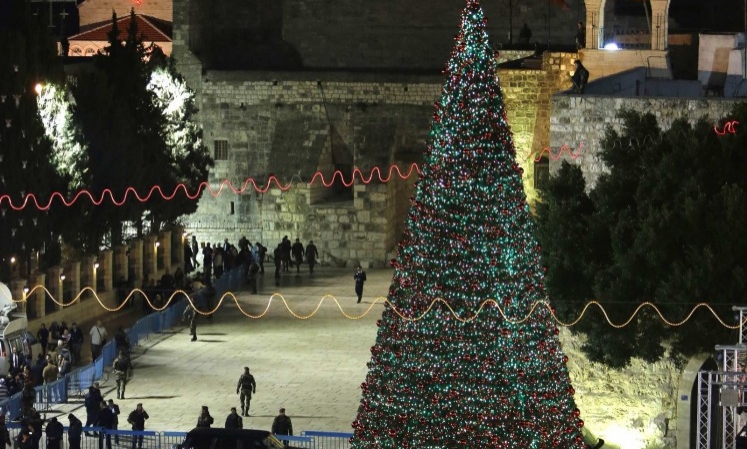
My husband and I spent Christmas 1999 in East Jerusalem, less than ten miles from Bethlehem where we were to attend Midnight Mass.
The Anglican Church of St George in Jerusalem had advertised a carol service at 9pm in the courtyard of the Greek Orthodox Monastery. We had arrived in Jerusalem in time to attend this service before going to Bethlehem. But armed bodyguards blocked the door to the courtyard because the PLO President, Yasser Arafat, was inside. We waited with a small group of Palestinian Anglicans, but the door remained locked, and there was no sound of carolling in the courtyard beyond.
Tofik Canavati's souvenir shop is directly opposite the courtyard. Mr Canavati commiserated and offered us a glass of Christmas wine. His shop window displayed an array of plaster holy infants, the biggest the size of a 10lb baby. We thanked him, wished him Happy Christmas, and drove the five miles to Bethlehem.
The illuminations began just beyond the Israeli checkpoint near the entrance to the town. They swung across the narrow streets of the old town. Jesus, Mary and Joseph, their figures picked out in lights, hung above the entrance to Manger Square. Bethlehem, hoping to make itself a base for tourists, was building hotels and refurbishing the town for the millennium, with money from the Palestinian Authority (which gets US and EU money) and the government of Sweden. Manger Square was criss-crossed with shallow trenches where paving was being relaid. Even so, that Christmas Eve, tables and chairs and a stage were set out in Manger Square, and the crowd watched and listened to choirs from all over the world. When we arrived in the square a Chinese choir was singing 'O Holy Night', and three tall Christmas trees, dripping with lights, swayed softly in the light, cold wind.
The streets and the square were packed with young Palestinian men. This was now their town, and they were out for the night, greeting friends, throwing firecrackers, eating corn on the cob, falafel and freshly-made pastries from street vendors. There seemed to be very few tourists. But that was because the church was blocked off from the rest of the square, and the tourists were queueing for Mass, almost unnoticed by a crowd celebrating freedom as much as Christmas.
Three churches share the Nativity site. The Orthodox Church and the Armenian Church are in the Basilica of the Nativity, founded by St Helena in the 4th century. Midnight mass was in St Catherine's Roman Catholic Church, built by the Franciscans in the 19th century. Midnight Mass is organised by the Latin Patriarch, at that time Patriarch Michel Sabah, and the Franciscan Order.
The town celebrations were organised by the Palestinian Authority, set up after the Oslo Accords were signed in 1995.
We walked to the square through a town ablaze with Christmas lights. Fireworks shot into the night sky and showered the crowds with coloured stars.
President Arafat and his wife, Suha, were expected to attend Midnight Mass. Clutching our tickets, we joined a queue of about 1,000.
The scout troup from Terra Sancta Franciscan school, smartly dressed in puttees, light brown uniform, red epaulettes, tassels and insignia, had the unhappy task of blocking the entrance to St Catherine’s to admit mass-goers one or two at a time. George Diek, a member of the troop, told me he was having a stressful Christmas night. "Complain," he said. "Write to the Latin Patriarch. There are too many tickets. Every year it's the same problem. We do not know what is happening. They don't tell us."
By the time we got to George and his fellow scouts, it was ten minutes to midnight and Mass had already begun. It had taken us more than two hours to move less than 100 metres from a narrow laneway at the northeastern end of Manger Square to the small door of the church. All the other entrances were closed and guarded. Yasser Arafat and his wife were already inside, their presence unavoidably altering the religious and political atmosphere.
When we finally got into the packed church, the Patriarch was reading the Gospel. It was clear the Presidential couple were as much the focus of attention as the altar.
They sat in the front row of only a few rows of chairs in the central aisle. For the rest of us it was standing room only. I stood on tiptoe to get a glimpse of Arafat and his entourage.
During the sermon, read by the Patriarch first in Arabic and repeated in French, one of the entourage rose and began to walk out of the church. Heads turned, the Patriarch paused, the dark-suited guest keeled over in a dead faint. At least two other mass goeers were similarly overcome by the heat and the occasion.
It was a long Mass, concelebrated in Latin, French and Arabic. Prayers for peace were said in more than a dozen languages. Balinese, Koreans, Scots, Belgian, Indians, Japanese and Palestinians - my companions during the hours of queueing - offered each other, and us, a sign of peace and said Happy Christmas in a melody of languages. It was a moment worth waiting for.
President Arafat shook hands and left the church before Communion. Heads turned again as he made his way out. His wife left shortly afterwards. The crowd diminished. Holy Communion was distributed. The mass was ending. When I looked up, there was a large baby in a manger on the altar, just like the biggest baby in Mr Canavati's shop window.
The Patriarch carried Jesus in the manger out into Manger Square and the Christmas bells of Bethlehem began to ring.
There will be no Christmas in Bethlehem this year. Palestinian leaders of Christian denominations have made an unanimous decision to cancel public celebrations because of the deadly war in Gaza.
There will be no Christmas tree in Manger Square. No sparkling lights, no Christmas parade, and probably no tourists.
And sadly, no sign of peace.
← Back