Lessons from a Lion
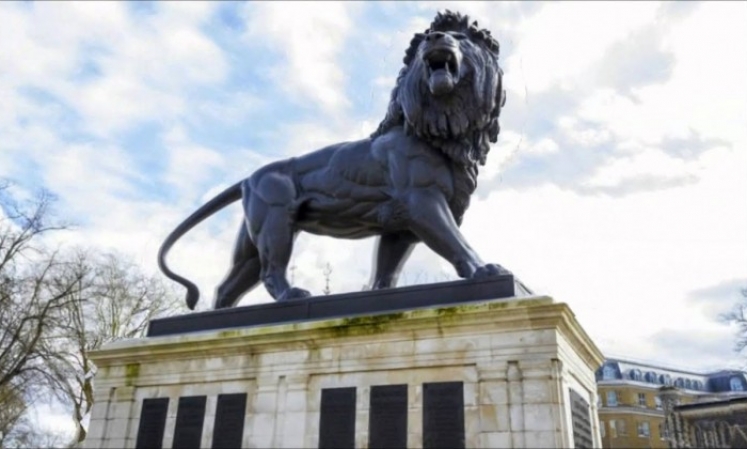
He reminds me that Afghanistan defeated the British in the 19th century, the Soviet Union in the 20th, and now the US and NATO forces this century.
He stands in Forbury Gardens in Reading, where I used to live. Five times as large as life, he growls voicelessly atop a limestone plinth in the centre of the park. I must have passed him dozens of times before noticing the words “Afghan Campaign” on the monument’s inscription.
It reads: "In memory of XI officers and CCCXVIII men of the LXVI Berkshire Regiment who gave their lives for their country at Girishk, Maiwand and Kandahar during the Afghan campaign MDCCCLXXIX to MDCCCLXXX" 1878 to 1880".
The names of more than 300 Berkshire men are listed on 12 bronze plates that line either side of the stone lion's plinth.
The lion first drew my close attention one afternoon in July when I noticed a wreath of poppies laid at the monument, too early for Rememberance Day, too fresh to have been there from the previous November. The handwritten inscription read: "In memory of the heroic stand by the last 11 at Maiwand."
Intrigued, I did some research when I got home. The British had twice invaded Afghanistan during the "great game" played against Russia for control of the warring tribes in the 19thcentury buffer zone between the British and Russian empires. The entire expeditionary force was wiped out in retreat in 1838, and the British fared little better in the second Afghan campaign commemorated by the lion.
In July 1880, during this second Afghan campaign, a British force of 2,700 men set out for Kandahar to put down a rebellion against the Emir of Afghanistan, who was a British protégé. They were sent to support 6,000 British-equipped "friendly tribesmen"; but the "friendly tribesmen" mutinied and joined the rebels. At Maiwand, the British found themselves facing about 25,000 Afghans, including irregulars they called "Ghazis". Sir Robert Baden-Powell described them in his “Memories of India”, published in 1915: "When they propose to go to Heaven the Ghazis dress themselves in clean white clothes and refuse to take food or to cut their hair until they have succeeded in killing an unbeliever. It is then best for them to get killed themselves before they have time to meet with temptation, and to commit further sins.. .." Massively outnumbered, the British were defeated. They lost nearly 1,000 men in the battle and on the retreat to Kandahar.
Baden-Powell arrived in Kandahar shortly afterwards. This is his account of what happened to the men of the 66th Berkshire Regiment:"Unknown to the British, a deep ravine ran in a horseshoe form almost entirely round the spot on which the brigade was standing. The brigade formed a square to receive the attack, expecting to see the enemy coming across the open, instead of which the Afghans poured down by thousands unseen, and then suddenly made their attack from three sides at once. Some Bombay cavalry, ordered out to charge them, swerved under their attack and charged into the rear of our own men, and the native infantry broke and ran with them through the ranks of the Berkshire Regiment, the 66th. These stuck to their post as well as they could but were driven back, and then held one position after another to cover the retreat of the remainder, but in the end were practically wiped out in doing so."
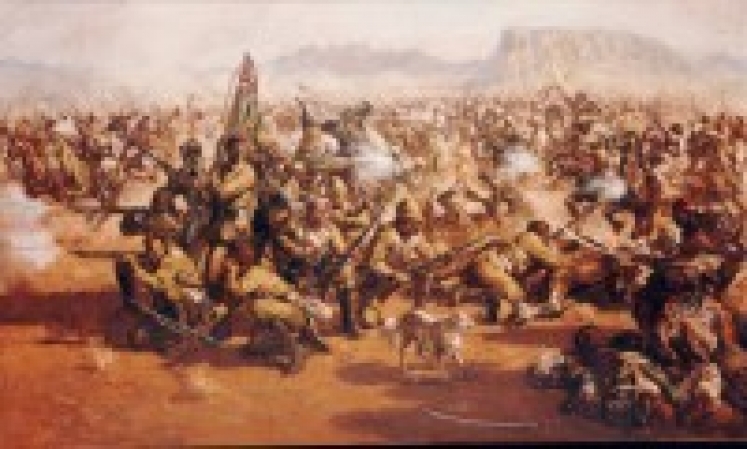
The remainder of the 66th rallied on the south bank of the ravine when the colonel unfurled the regimental colours, around which, as he fell, a group of about 200 formed. They were surrounded, their commanding officer was dead and they were doomed; but, losing men all the while, they retreated to a mud-walled garden where a second stand was made by the remaining officers and men of the 66th. These in turn supported the colours until each soldier was shot down.
The Afghans saluted the courage of the last of the 66th. "Surrounded by most of the Afghan army, they fought on until only 11 men were left, inflicting enormous loss on the enemy," wrote one of the Afghan artillery officers. "These men charged out of the garden and died with their faces to the foe. Their conduct was the admiration of all who witnessed it."
The soldiers detailed to guard the wagon train and service the artillery survived. So did Bobbie, the regimental mascot - a small, white mongrel terrier with black spots. He went missing on the battlefield but somehow made his way back to Kandahar, 50 miles away. In June 1881, Queen Victoria gave Afghan Campaign medals to the survivors of the 66th Regiment, and Bobbie.
Eighteen months later, Bobbie was run over by a hansom cab. The regiment had him stuffed, and you can still find him in the Regimental Museum in Reading, standing in a glass case, with a red and green ribbon around his neck to hold his Afghan medal. (Bobbie is featured in Jilly Cooper's book 'Animals in War'.)
Kipling may well have had Maiwand in mind when he wrote the third verse of “The Young British Soldier”:
"When you're wounded and left on Afghanistan's plains -
And the women come out to cut up what remains -
Then roll to yer rifle, and blow out yer brains
And go to yer God like a soldier!"
When I read about the fall of Kandahar, and the march of the Taliban towards Kabul, I think about the stone lion and the stuffed dog, and the much-quoted, usually unheeded warning of George Santayana - "those who cannot remember history are condemned to repeat it."
← Back