Borders change. Identity doesn’t.
Derry/Londonderry came immediately to my mind as we drove into the town of Brixen/Bressanone in Sud Tirol/Alto Adige.
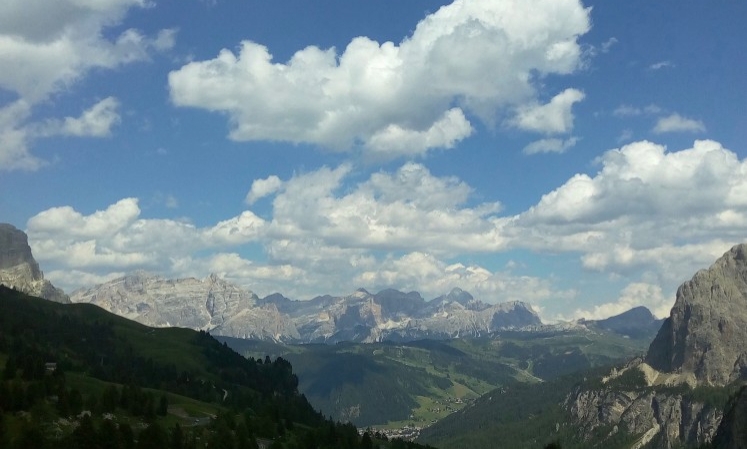
It is a peaceful part of the world, gateway to the Dolomites, a land of mountains and meadows, vineyards and orchards, and Ötzi, the Iceman — preserved in the ice for centuries, now on display in the archaeological museum of Bozen/Bolzano. You can walk for miles in the mountains, ride cable cars between mountains, hike or bike between unspoiled towns with marvellously decorated churches and castles, from gothic to baroque.
It is also a region that knows about competing identities and cultures.
At a time when Ireland was trying to shake itself free from the British Empire, South Tyrol — German in language and culture — was a contented province of the Austrian Hungarian Empire and felt itself part of the historic German Lands.
Germany had become a nation. So too had Italy. And the latter coveted South Tyrol because of the Brenner Pass through the Alps. If Italy controlled that pass, it would be geographically more secure.
At the beginning of WW1, Italy, although part of the defensive Triple Alliance with Germany and Austro-Hungary, was neutral. One year later, in 1915, a secret treaty — the Treaty of London — promised to reward Italy with South Tyrol, for abandoning neutrality and joining the war on the side of the Allies. In 1918, under the Treaty of St Germain, South Tyrol duly became part of Italy.
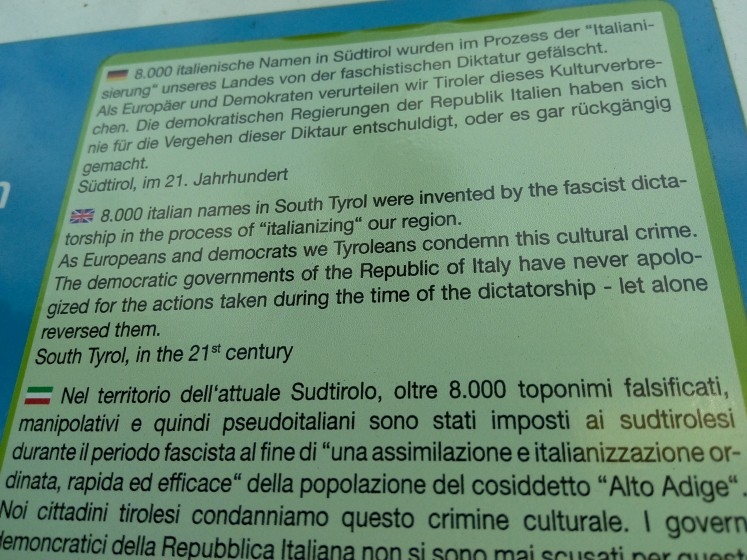
Four years later, Mussolini came to power and began a programme of forced Italianization of South Tyrol. Eight thousand place names were changed from German to Italian. Overnight, Brixen became Bressanone, Meran became Merano, Bozen was now Bolzano, and so on. Italians were incentivised to move into the region. The teaching of German in schools was forbidden. German speaking teachers were replaced by Italian speakers.
In an echo of hedge schools in Ireland, a priest, Fr Michael Gamper, and a lawyer, Dr Josef Noldin, created Katakombenschule, which smuggled schoolbooks in German from farm to farm. German speaking teachers who'd been dismissed taught in 'farm lessons'. The penalty for being caught was prison, and deportation to Southern Italy for repeat offenders.
When Hitler came to power in Germany, the South Tyroleans thought he would support their desire to be re-united with Austria. Instead, Hitler gave them a choice: be Italian citizens, or be transferred to the German settlement of the Crimea. This latter relocation never happened. Those who left South Tyrol were mostly settled in Western Poland, which had been annexed by Germany. They were expelled, or killed, after the war.
The victorious allies decided South Tyrol should remain part of Italy. Austria and Italy negotiated an agreement. German could again be taught in schools. Both German and Italian were made official languages. But new arrivals from other regions in Italy brought new tensions to Sud Tirol/Alto Adige. Resentment grew. German South Tyroleans campaigned for re-unification with Austria.
In the 1960s, the South Tyrolean Liberation Committee began bombing public buildings, monuments and electricity stations. The campaign became more violent with attacks on police and soldiers. Twenty-one people, including four activists, died.
In 1969, Austria and Italy agreed a deal. Austria would not interfere in the affairs of South Tyrol, Italy would grant the region autonomy. Tensions eased. But it took another twenty years for reforms promised by Italy, to be implemented.
The region where we enjoyed an idyllic holiday, is today the richest part of Italy. The entry of Austria into the EU in 1995, the common currency and the disappearance of the border between Italy and Austria helped make Sud Tirol/Alto Adige peaceful and prosperous. The historic region of Tyrol, stretching across the border between the two countries, now forms a Euroregion of intense co-operation.
Identity still matters. Resentment at the Italianisation lingers. In Brixen/Bressanone and other towns in the area, posters with maps and information inform the tourist that in 1922, eight thousand place names were changed overnight - and "the Italian Government has never apologised".
The region is approximately 70% German speaking, 26% Italian speaking. Ladin, a local dialect, is spoken by the remaining 4%.
Brixen/Bressanone, where our holiday was based, felt entirely German. But the Italian influence was evident, especially in food and wine. Imagine the best of German food - speck, dumplings, hearty stews, delicious breads, Riesling — combined with varieties of pasta, truffles, bagna cauda, bollito misto, Italian cheeses, desserts and wines. We ate well.
And we thought about Northern Ireland, with its competing British/Irish identities, enjoying, like Sud Tirol/Alto Adige, a long-negotiated peace. A peace partly achieved by both cultures belonging to a larger identity, Europe.
← Back