Galeón Andalucia
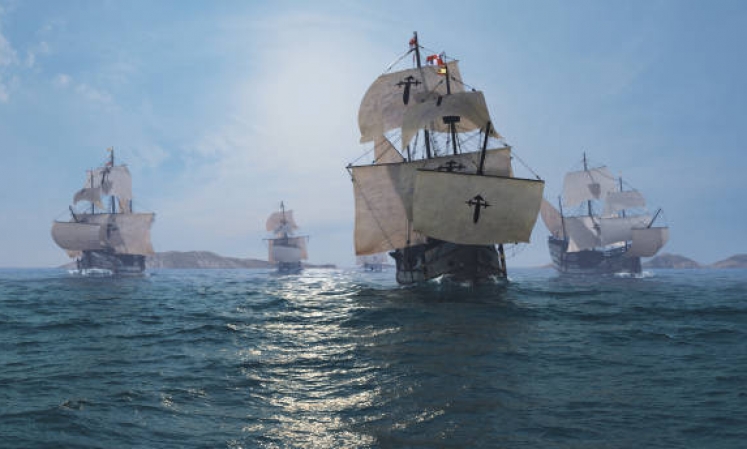
It paused a few nautical miles from Sligo port to drop a wreath at Streedagh Strand in memory of the three ships wrecked there in 1588 after the defeat of the Spanish Armada in the naval Battle of Gravelines.
The safest route home for the defeated and depleted fleet was round the north of Scotland and home via the North Atlantic. Safe from pursuing English ships, but not from the weather. Of some 130 ships, only half managed to struggle back to Spain. The rest were wrecked in violent storms on the coasts of Scotland and Ireland, three of them at Streedagh Strand, where one survivor, Captain Francisco de Cuellar was washed ashore. A year later, he got back to Spain, where he wrote an account of his experiences in Ireland – from being attacked by both English troops and marauding Irish robbers, to being sheltered by Irish clan chieftains.
In May this year, I took one of his direct descendants, Fernando Cuellar, to Streedagh Strand and to Lough Melvin, in County Leitrim, where Captain de Cuellar found refuge with the McClancy family in Rossclogher Castle, and where he helped to build a defensive wall against attacks by English troops.
Nothing remains of the three Armada ships wrecked at Streedagh. Little remains of the McClancy castle. The roof and most of the walls are gone. Ivy smothers what’s left of this former stronghold. But Fernando was happy to walk the strand, gaze on the castle ruins, and feel a connection to his ancestor.
Fernando has an even closer ancestor with links to Ireland. His great uncle, José Places, a refugee from Franco’s Spain, died and was buried in Northern Ireland. Fernando knew little about how this came about. He knew only that his great-uncle had been a sailor on a ship escaping from seizure by General Franco during the Spanish Civil War. He thought the ship had docked in Derry and that his great-uncle, José Places, was probably buried there, but possibly in Belfast.
I met Fernando when my husband, Richard, and I were visiting an old friend - my former BBC colleague - Brian Barfield, who now lives in Prades in the French Pyrenees. Fernando is his neighbour and good friend. When he heard I lived in Belfast, and that I knew about Captain de Cuellar and his adventures in Ireland (my late brother, Tony McAuley, made a programme about Captain de Cuellar when he was a BBC producer) he told me also about José Places. And he was delighted to accept our invitation to visit us and find out more about his ancestors.
I knew the person to ask about José Places — Tom Hartley, former Sinn Fein Lord Mayor of Belfast, historian, author of a book series about Belfast cemeteries, ‘A History of Belfast – Written in Stone’. Tom has an encylopaedic knowledge of Belfast, its cemeteries and who is buried in them.
Tom told me José was buried in Belfast City Cemetery. “José died on 2nd March 1941. He was 43 years old. His address is given as Purdysburn Mental Hospital and 232 Duncairn Gardens. (Nothing else seems to be known about him). He is buried in the same grave as Luis Diaz de Lasaga about who quite a lot is known. Luis died on 27th April 1943. Luis, from the Basque country, was the captain of a ship that docked in Belfast sometime in 1937. His ship was subsequently nationalised by the fledgling Basque government. This led to a dispute with the Spanish shipowners who brought issue to the British courts.“
As a result of the dispute, Captain Luis Diaz de Lasago and his crew, including José Places, were berthed in Belfast for over a year. They were, in effect, refugees from the Spanish Civil War. Along with other refugees, they were looked after by a Belfast Presbyterian couple. Luis spoke out against the government of Franco and at the Belfast May Day rally in 1938, he called for support for the Republican Government of Spain. He became a captain in the British Merchant Fleet. In April 1943, he was seriously injured when his ship was sunk. He died in St George’s Hospital in London. His remains were brought to Belfast where he, and the other Spanish refugees, were in the grave of the family who had looked after them.
Tom Hartley met us at Belfast City Cemetery and took us to the plot where José Places and the other sailors are buried. Fernando was overcome with emotion. He spoke in Catalan, the language he shares with his great-uncle. He asked Tom Hartley to say a few words. Tom spoke eloquently about brotherhood and peace, much needed in our world today.
← Back