A Saint Stephen’s Day custom in Ireland
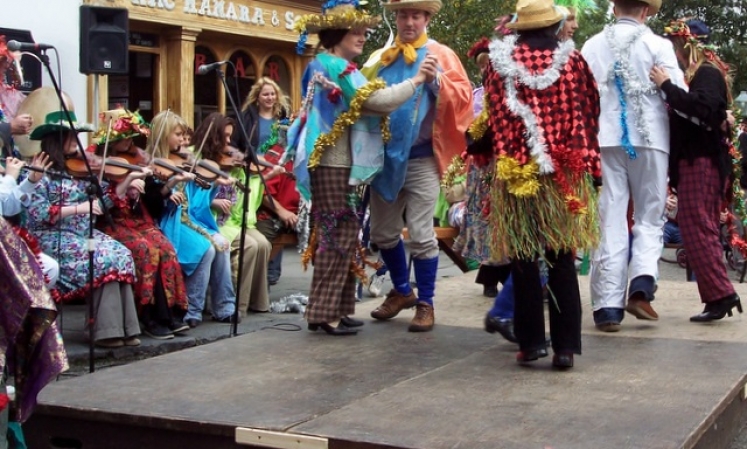
The poet, Carol Ann Duffy, wrote about this tradition in the beautifully illustrated The Wren Boys. I included the custom in a chapter of 'French Secrets' when Honor, home from France for Christmas, meets Diarmuid, her old friend and sparring partner.
'Diarmiud remarked on my good spirits when I met him on Stephen’s day.
“I feel great.” I said. “Great to see you. Great to be here. Where’s Katy?” I glanced around Finnegan’s.
“She’s with her dad in Barbados.” Diarmuid smiled at me. “To tell the truth, I’d rather be here. Paddy serves the best stout in Ireland. No. In the world.” He raised his glass. “Look at that creamy head. You could take a spoon to it.”
He was wearing a straw wig and pretty much the same clownish outfit as in previous years - a yellow checked shirt, red braces, baggy brown trousers, hobnailed boots. Most of the regulars were in similar gear. I was one of the few conventionally dressed. I preferred to take my place among the spectators when Diarmuid and the other Wren Boys paraded through the streets playing tin whistles, beating the bodhran, singing, collecting money for charity.
“It’s a funny thing,” Diarmuid looked around at the assembly of clowns, Santa Clauses, leprechauns and motley yokels. “The Wren Boys used to hunt the wren and tie it to a holly bush. That was the tradition.”
“Parading the poor dead bird.” I shuddered.
“Now it’s a fake bird, we do it for charity, and this year’s it’s the Irish Wildlife Trust. Saving the wren from extinction. Irony, eh?”
“And saving the tradition,” I said.
My lunchtime drink with Diarmuid on Saint Stephen’s Day was another tradition. He and his parents usually spent Christmas with relatives near Ballybreen. Diarmuid and his cousins were enthusiastic Wren Boys. I followed them as they pranced through the streets waving their collecting tins, shouting “The wran, the wran, the king of all birds, Saint Stephen’s Day got caught in the furze. Although he is little his family is great. Come out your honour and give us a trate. Hurrah, me boys, Hurrah.”
Afterwards, when the money was counted and handed over, we all crowded into the pub and when the laughter and the talk died down and the cousins drifted back to the house, Diarmuid and I went for a walk.
A blustery wind blew bits of paper and empty polystyrene food cartons along the pavement. We put our heads down, funnelling the cold air past our ears, and walked briskly to the beach.
”How’s Hugo?” Diarmuid shouted into the wind. “Is he coming over at all?”
“He’s skiing in Val d’Isère.”
Diarmuid put his arm around me and gave my shoulders a quick squeeze in commiseration.
“I might join him after Christmas if I can get a standby flight,” I said.
We walked towards the water’s edge.
“That’s where you kicked over my sandcastle.”
“What?”
“You ran over to me with your pigtails flying and your face blazing and you jumped on my lovely fort with its turrets and ramparts.” Diarmuid shook his head, all mock sorrow. “Don’t you remember?”
“It was a long time ago.” I said. “But if you’ll accept a late apology, I’m sorry.”
“Doncha know, babe,” he said in a Boston accent, “love means never having to say you’re sorry?”
“That’s the dumbest thing I ever heard,” I said. “And that’s a line from a film too.”
We stood smiling at each other, but I felt as though something solid had suddenly slid sideways. I was unsettled for a moment, oddly self-conscious. Like a child again.
“I’m sorry I wrecked it.”
“Me too,” he said.
← Back